Driving Day Heading West
2018-09-13
Seattle, WA and MO with a cameo by ID
Today was a repositioning day as I drove to Seattle to meet my girlfriend at the airport. Hopefully the addition of someone with a better sense of humor improves the blog some; at least I've kept the bar low thus far. She also has a really good eye for the creative side of photography, assuming the weather cooperates.
I'm also getting over my cold, which is a mixed blessing. You never seem to get two colds or a cold and the flu at the same time. I don't know why that is, and last time I checked neither does medical science. Still, it's a cool trick however the body does it. I guess I'll soon be susceptible to my next illness.
Without much to talk about, I figured I'd make a few notes on photography. I primarily use a Canon 7D Mark II digital SLR camera body with a 24-70mm lens. I don't think that Canon is better or worse than Nikon, but the guy who helped me get started with my photography (thanks Jeff!) uses a Canon and thus to tap his vast knowledge, so do I. Besides the 24-70mm lens I also have a 100-400mm zoom lens for wildlife. Since this lens weighs over three pounds I don't tend to carry it on longer hikes. I do usually carry my wide angle lens which I pull out occasionally. I also have a 30mm f/2 prime lens which is good for low-light situations such as caves.
When I head out on the trail, I carry 6-10 lbs of camera gear along with a couple pounds of food and water and another pound of first aid kit, flashlight, compass, bear spray, etc. The extra weight can be a drag over the course of 10 miles, but I have decent camera packs which help distribute the load and I just keep telling myself that it's a good workout. I typically carry a fair amount of the gear and/or a few extra bottles of water on my training hikes in French Creek State Park so that I'm used to it.
When I'm out on the trail I can usually frame a shot and take it pretty quickly. When walking I typically keep my camera on f/11 or f/13 with a shutter speed of 200th-400th on overcast days and closer to 1000th if it's sunny, and an automatic ISO so that easy landscape shots will simply require framing. If you don't know what these settings mean, don't worry - those settings are not far off what your point-and-shoot or phone camera will use automatically.
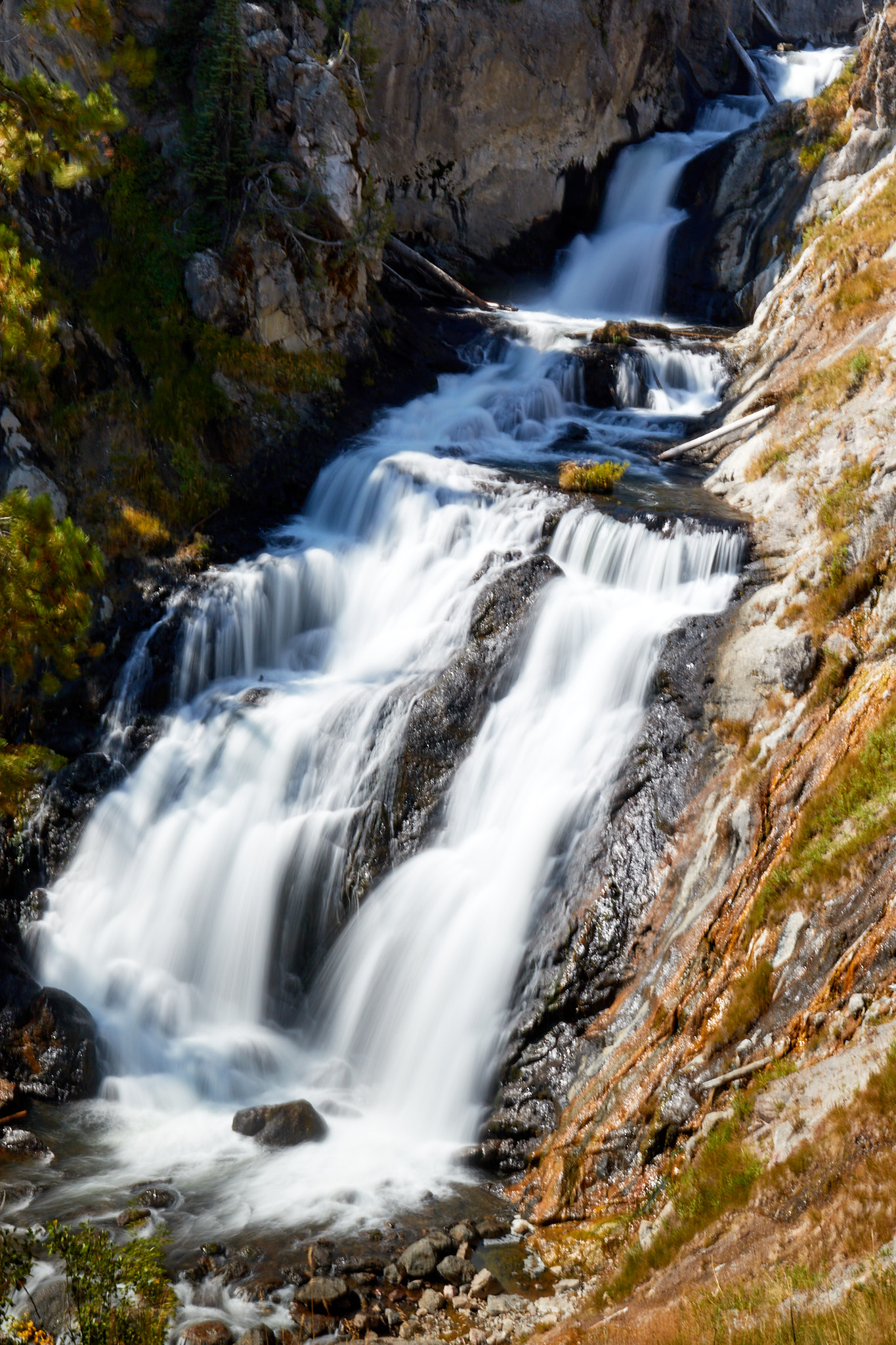
I will admit that sometimes it takes a lot longer to get the shot if I need to add a filter or set up the tripod. Five or ten minutes to get a shot isn't uncommon for those situations. Depending on the shot, I may use a polarizing filter to get those blue skies or reduce the glare on the water. I also carry a couple of neutral density filters, which I use to make waterfalls look like cotton candy. Finally, I have a graduated neutral density filter. This doesn't get a lot of usage, but places like Hidden Falls and Mystic Falls where half of the falls was in full sun and half was in shade was a perfect location to break it out.
I take a lot of pictures, figuring that some will come out pretty well and most (70-90%) will go into the bit bucket. I've taken about 2200 pictures so far this trip and it will take me many hours to go through them all, keeping the favorites and discarding the rest as well as improving many of the chosen with crops or color correction. I will do that later; the monitor on this laptop is a poor substitute for the bigger monitor at home. So the pictures you've seen on the blog have mostly been untouched except for the occasional necessary crop (particularly on wildlife pictures).
Each picture I take is about 25 MB in RAW format. My free blog site has a 500 MB cap so I could only do 8 at that size. That's a moot point because they don't accept RAW format anyway. Thus I import them into Lightroom and save out jpegs for the web. I limit it to 1.2 MB per jpeg file which I've empirically found to be the smallest size that works for all my pictures. For comparison, to get a 4x6 print I usually generate 4-6 MB jpegs.
From my description, you should know the answer to the oft-asked "should I get a camera like that?" These days I like to answer that question with a question. For example, "what do you plan to do with it?" or "what sort of pictures do you like to take?" or simply "are you crazy?" Sure, there are a lot of things that this camera can do that your phone can't, but really most of the time you don't care. Phone cameras are wonderful event recorders (and as they have become ubiquitous, we can now be sure there is no bigfoot). The typical thing that makes people buy a larger camera is wanting a lot of zoom. I can understand it; pikas and marmots aren't all that big and they don't run towards you. But you can get a nice light high-zoom camera that will do just about everything you want and total in under two pounds (probably under one) if you really feel the urge then go that way. Plus, many people never buy a second lens and just carry whatever came with the camera forever.
But if you really do find yourself wanting a DSLR camera, then make sure you have fun with it. There are so many things you can do, even with just a stock lens. Find ways to bring the camera along so that it enhances rather than interferes with what you are doing.
Hiking distance: 1 mile in pursuit of supper